How to teach your dog to control it’s “chase” instinct as it relates to pace. (Part 1 of 2)
Without knowing how to adjust pace, your dog won’t be able to convey to the stock that it's trustworthy. Instead, your dog will continue to rush the stock on the fetch.
You’re in the right place as this is by far one of the most common problems I deal with when it comes to training stock dogs.
In this training session, I’ll also give you some things to look out for along the way, mistakes I made before I worked out my training system, and ones I still see other stock dog handlers making.
Ready? Let's Go!
Step #1: List your own strengths & weaknesses
Before you can review your dog’s training requirements, you’ll want to take your time to analyze YOURSELF.
So, the first thing you need to do is:
Identify what’s working- for example, your voice and body language calmly convey to your dog what’s expected.
Next, identify what’s NOT working- for example, your timing is off because you aren’t watching the stock enough.
Once you have honestly evaluated yourself, take a moment to write down what you're willing to change in order to have changes in your dog’s training program.
What are you NOT willing to change?
Many people skip this foundational step and then wonder why they’re not progressing with the training. Don’t let that be you!
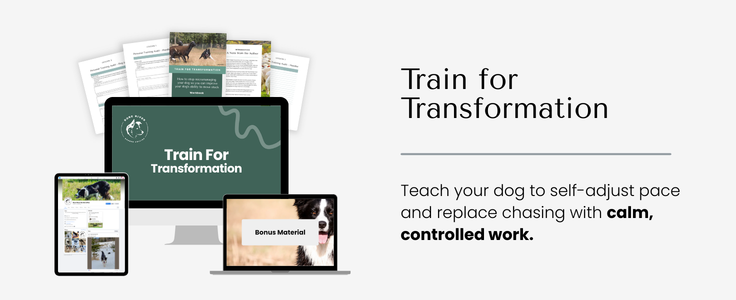
This is a crucial foundational step that will set you up for success later on. And each step is a building block for the next, so don’t even try to jump ahead! :). We really emphasis the importance of this foundational training in our Train for Transformation six-part series. LINK HERE
All done? Great job! Let’s move on to Step 2.
Step #2: List your dog’s strengths & weaknesses
At this point, you’re probably thinking that this is a huge time suck and not really “training”.
You may even be wondering, “Why spend the time with this theoretical "stuff "?
If you hang in there, it will make sense, promise. What we’re doing is pulling this all together into a short step-by-step guide so that you can teach your dog better control of pace. You might also want to review the topic of BALANCE HERE
Now it’s time to copy what we did in Step #1 EXCEPT replace you with your dog!
The reason this step is important is that it will help you achieve a clear and concise path to solving your training block and make it easier to target.
Here are some tips to help you move through this step quickly:
How does your dog respond to the stock? Fast, slow, inconsistent?
Be objective. Are your observations subjective? What do you see right NOW?
Would an expert opinion be valuable?
What to look out for:
When I first started I made excuses for my dog. I remember thinking, “my dog knows best, this is her instinct!”.
In a recent podcast, Scott Glen discusses the point of not making excuses for both your dog & yourself! LINK HERE
Step #3: Teaching the dog to self-regulate movement
Are you starting to get excited? I hope so. We’re just about there.
You may be feeling a bit overwhelmed, and that’s perfectly normal. Any time you’re trying something new, it takes a minute to process it. Just be patient and stay with it.
Next, you are going to specifically focus on the dog’s approach to the stock. This means EVERY TIME the dog turns towards the stock, you will be intentional as to how this is done.
While you’re doing this, make a note of how much or little movement they use near the flight zone. If the dog is bursting through the flight zone each time, then applying pressure in the form of a block with your body and/or tool such as a bag or stick, will be needed. Once pressure is applied, immediate release will convey to the dog that you are happy.
The release is almost MORE IMPORTANT than the block!
If the dog is not applying enough forward movement, you will need to make sure you are NOT blocking, but rather encouraging forward movement.
Make any adjustments you need to make before you move on.
What to look out for:
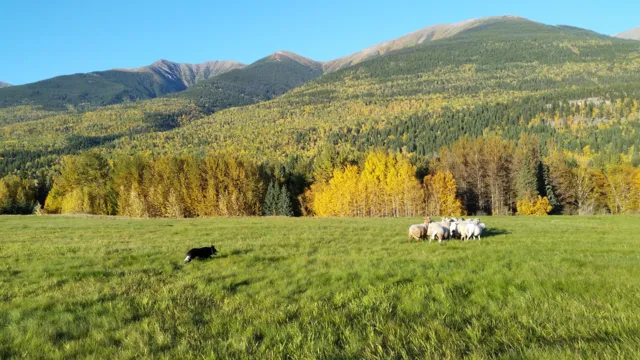
It may be hard to zero in on what to look for, but the stock will give you an idea. Watch your stock! Are they running over you or running down the field? Then your dog is putting too much pressure on the flight zone and instead of “containing” the stock is “chasing” the stock!
What you can do is teach your dog to approach the stock properly, by not being too far away from the dog & stock and try being silent sometimes as opposed to controlling with a stop each time. Mix things up!
In Part 2 of this training blog, we will continue with the next 3 steps which are key to developing pace on your dog and discouraging the “chase”.
Are you ready to develop a true partnership with your dog?
Join the Train for Transformation program. The series that's all about STOPPING the uncontrollable "chase" and teaching your dog to self-regulate it's pace.